Now Go See It is reader-supported. When you buy through links on our site, we may earn an affiliate commission.
Fort-de-France cruise port guide for Martinique with walking directions, taxis, safety notes, top sights, excursions, local food picks, and map links.

How To Get To The City Center From The Fort-de-France, Martinique Port
The quick reality check on where you dock, what’s walkable, and when a taxi makes the day smoother.
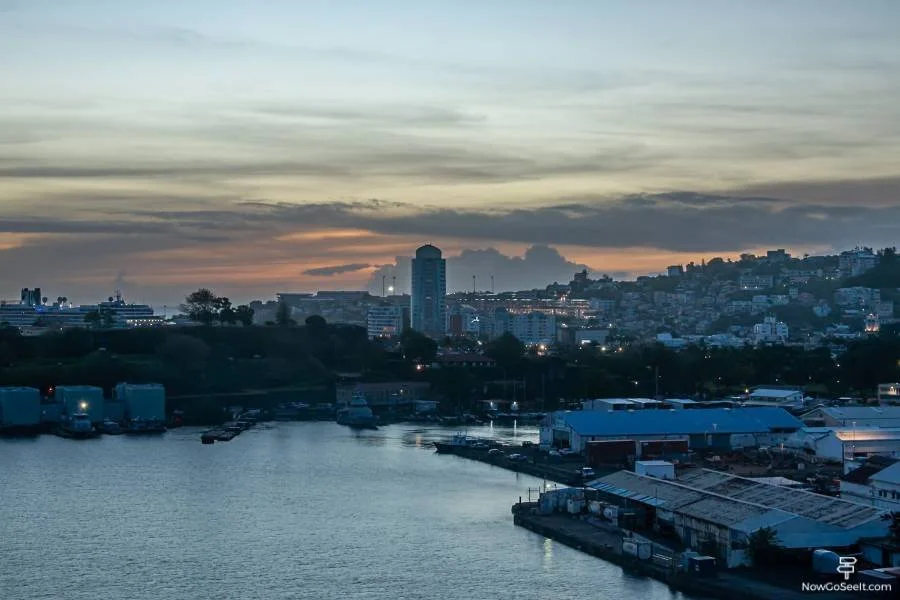
Most cruise ships use either the Pointe Simon Cruise Terminal or the Tourelles Cruise Terminal, and which one you get changes the first 20 minutes of your day. Pointe Simon is close to the downtown grid, so you can walk straight into town and be “doing stuff” quickly. Tourelles is slightly farther out and feels more port/industrial, so you can choose to take a short taxi into the center or head out on foot.
Taxis are typically lined up on cruise calls. If you prefer walking from Tourelles; it’s doable, plan for a 15-minute, slightly uphill walk. The simplest plan is to start downtown, knock out the main sights in a loop, then come back the same way you arrived.
Is Fort-de-France, Martinique Safe?
A practical look at what cruise visitors experience in daylight downtown, plus what can change during protests or unrest.
Fort-de-France is generally fine for a daytime DIY visit, especially if you stick to the busy downtown streets where you’ll naturally be walking. The main issue tourists run into is petty theft, not anything dramatic, and it tends to be the same situations you’d expect in any city center.
Martinique has had periods of protests and disruptions, and those can flare up without much warning, so it’s worth staying flexible if you see streets blocked or police activity increasing. If your ship stays late, the easiest way to keep it low-stress is to avoid empty routes back and use a taxi for the return. Fort-de-France isn’t a place where you need a guide just to walk around downtown in the middle of the day, but it also isn’t a theme-park version of the Caribbean.
Keep your day tight, keep your return plan simple, and you’ll be fine. If something feels off in the moment, there are plenty of easy alternatives nearby without forcing the original plan.

Airline Miles and Hotel Points 101
We share tips and tricks for credit card points and miles. These tools help us save money on our trips around the world by allowing us to accumulate airline and hotel points.

About Fort-de-France, Martinique
What this port day actually feels like: a real capital city, French systems, and an itinerary that works best when you keep it compact.
Fort-de-France is the capital of Martinique, and it reads like a working city first and a cruise stop second. Martinique is part of France, so you’ll see French-style infrastructure, French language everywhere, and pricing that often lines up more with a European destination than a bargain beach town.
The currency is the euro, but US Dollars and credit cards are widely accepted. The downtown core is compact, which is why this is a strong do-it-yourself port: you can stack multiple sights without spending half the day in a vehicle. Shops and offices keep local hours, so a quick glance at opening times can save you from arriving at a locked door and doing the annoyed tourist pivot.
If you want a clean cruise-day win, do the central highlights first, then decide whether you have enough time for one bigger add-on. The mistake people make here is trying to do “the whole island” plus a full city day, then realizing traffic and timing are not negotiable. Fort-de-France works best when you plan like you’re going to be back on the ship early, even if you technically don’t have to.

How To Get Around Fort-de-France, Martinique
The easiest way to cover downtown on a port day, plus when to use taxis or an organized tour instead of figuring out local transit.
Downtown Fort-de-France is walkable, and walking is the best tool you have here because most key stops are clustered close together. If you dock at Pointe Simon, you can treat the day like a walking loop from the port and back. If you dock at Tourelles, the walk to the city is slightly longer, but still works as a manageable loop.
Public transport exists, but we found it impossible to navigate. We waited for a bus that never came for an hour after spending 45 minutes searching for an unmarked bus stop. Ferries to local islands are popular but unpredictable. It’s advisable to leave lots of extra time for your return if you get onto a ferry. Also, you may be shocked by things like the ticket booth completely closing for an hour for a lunch break.
For a single cruise day, it’s usually only worth it if you already know exactly where you’re going and it clearly saves time over waiting for a taxi. Taxis are the default “bridge the gap” option if you want to add one stop outside the downtown grid without turning your whole day into transit math. However, taxis are extremely expensive, so manage your financial expectations.
If you want a structured day without the logistics, this is a good port to compare cruise line excursions with options on Viator or GetYourGuide, because pricing and group size can vary a lot. If you do a self-guided day, pick an order and stick to it so you’re not zig-zagging across the same blocks repeatedly. The biggest upgrade you can give your day isn’t a special ticket or hack; it’s simply not wasting time on unnecessary backtracking.
What To See In Fort-de-France, Martinique
A walkable, cruise-friendly list of the best downtown sights, built for a one-day itinerary without wasting time.
Start with the stops that are closest together, then work outward so your return to the ship stays simple. This list is built so you can do it on your own with minimal transport, especially if you keep your route in a loop instead of crisscrossing downtown. If you like architecture, you’ll get plenty of it here without committing to a long museum-only day. If you like markets, Fort-de-France gives you multiple ways to shop that feel local instead of purely cruise-terminal. If you like quick cultural context, the museums here are manageable in a port schedule. If you want a light “beach moment” without leaving the city, there’s an option for that too. The key is deciding early whether you’re doing a downtown-only day or pairing downtown with one larger excursion.

Fort Saint-Louis
Map: Google Maps
Website: Link
Fort Saint-Louis is a 17th-century fortress that’s tied to how Fort-de-France developed as a strategic harbor. It’s an active military site, so access is typically by guided visit rather than wandering wherever you want. The free version is to focus on the exterior ramparts and bastions because that’s where you see how the fort was designed for defense and why the location dominates the bay. Look for the cannons, the sea-facing angles, and the view lines over the harbor that explain why this spot was chosen. Tours are offered Tuesday-Friday 9am - 12pm and 2pm - 3pm, and Saturday, 9am - 12pm, with tickets only available in person. Even if you don’t go inside, it’s still worth walking the waterfront nearby so you can see the fort from multiple angles.
Bibliothèque Schœlcher
Map: Google Maps
Bibliothèque Schœlcher is the famous downtown library with an unusual backstory: the structure was originally erected in Paris, then dismantled and reassembled in Fort-de-France. The building is the attraction here, especially the iron-and-glass design and the central dome. Make sure you look up at the ceiling details and stained glass. The library is named for Victor Schœlcher, and part of the point of visiting is seeing how his legacy shows up in the space and displays. Take a minute to scan the upper interior details near the ceiling line, where names and decorative elements were intentionally placed as part of the design. This is also a very efficient stop because you can get the full payoff in a short visit. If it’s open, go inside; the exterior alone doesn’t deliver the best parts.

Cathédrale Saint-Louis
Map: Google Maps
Website: Link
Cathédrale Saint-Louis is one of the most distinctive cathedrals in the Caribbean because the current building was constructed with an iron frame after repeated disasters, which is why it’s sometimes nicknamed the “Iron Cathedral.” Inside, the iron arches are the main thing to notice first; they shape the entire space and make it feel different from stone cathedrals in Europe. Look for the stained-glass windows and how the light changes across the nave as you move through. If the pipe organ is visible, take a moment to spot it, because it’s one of the interior highlights. You’ll also see carved interior elements like the pulpit, which stands out against the metal framework. This is an easy, central stop, so it works well early in your loop or as a quick reset between the markets and shopping streets.
Parc De La Savane
Map: Google Maps
Parc De La Savane is the central downtown park, and it’s more important than it looks because it sits at the foot of Fort Saint-Louis and anchors the main cluster of sights. Historically, it was used as a military drill field, which explains the scale and layout compared to a small neighborhood park. It’s also one of the easiest places to orient yourself because several headline stops sit right around it, including the library and the waterfront. If you’ve heard about a statue of Empress Joséphine here, that’s old news: it was demolished in 2020. What you should look for now is the way the park connects the city center to the bay, plus any kiosks and temporary setups that appear on cruise days. There’s also a small beach area called La Française if you’re looking for a no-frills, easy-access beach. It’s a practical place to pause, but the real value is how it stitches your walking route together.

Grand Marché Couvert
Map: Google Maps
Grand Marché Couvert (often referred to as the spice market) is the downtown market that cruise visitors actually use because it’s central and packed with “Martinique staples” you can take home. The market is known for spices, local flowers, tropical produce, Creole-style apothecary items, liqueurs, souvenirs, and small crafts, plus there are restaurants inside serving local dishes at lunch. If you want the best experience, go earlier in the day when vendors are fully set up, and the selection is better. Look specifically for spice blends, vanilla products, madras-pattern items, and local bottled mixes like rhum arrangé, since those are the common “this is what I bought in Martinique” purchases. If you want a very Martinique-specific souvenir, keep an eye out for a bakoua hat, which is widely associated with local craft traditions.
Rue Victor Hugo
Map: Google Maps
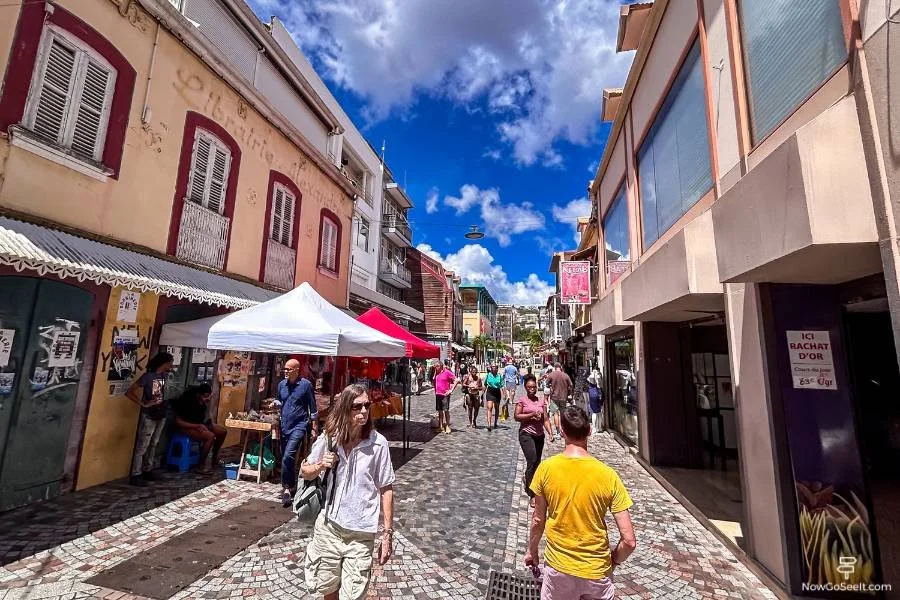
Rue Victor Hugo is the downtown shopping street most visitors use because it’s where you’ll find a concentrated stretch of fashion, beauty, and typical city-center retail. If you want an easy planning move. What to look for here is the mix: French brands alongside smaller local shops, plus cafés and bakeries that make it easy to build a quick snack stop into your route. If you’re shopping for practical souvenirs, this street is more “modern retail” than “market crafts,” so it’s best for things like cosmetics, accessories, and everyday items. If you’re not trying to buy anything, it still works as a useful connector street between the market area and the rest of downtown.

We’re on YouTube!
The same great content without all the pesky reading!

Rue De La République
Map: Google Maps
Rue De La République is one of the main commercial streets in the center, so it’s useful if you want the “real downtown” feel rather than only hitting standalone landmarks. The most practical way to use it is as a route: walk it as part of your loop while you’re moving between the market zone, the central squares, and the civic buildings. What to look for is the building frontage and street layout, because the street gives you a clear sense of how compact and walkable the core is. This is also where you’re likely to see everyday shopping patterns: quick errands, small stores, and people commuting through the center. If you want a simple “walk-and-shop” stretch, this is the street that makes it easy without needing a plan. Don’t expect a single headline attraction here; the value is the street itself as a cross-section of downtown.

Hôtel De Ville De Fort-de-France
Map: Google Maps
Hôtel De Ville De Fort-de-France is worth a quick look from the outside because it’s the actual municipal headquarters and a clean reference point for “this is the capital city, not just a port stop.” You’re not coming here for a long interior visit; the value is seeing the civic façade and the city’s official home base. Look for the official signage and the way the building is positioned in the downtown grid, because it helps you understand the city’s center of administration. If you like architecture, the key is comparing the city hall’s official look to the older historic buildings nearby. This stop is most useful as a quick add-on while you’re already walking downtown, not as a standalone destination.

Fontaine Gueydon
Map: Google Maps
Fontaine Gueydon is not just a decorative fountain; it was built as part of Fort-de-France’s water supply system and is tied to how the city managed water distribution. The structure is designed around a large cascade: water spills from a vault-like feature into a basin system that historically fed pipes to different districts. During our visit, it wasn’t running, and from the looks of it, it hasn’t flowed in a long time. But is it still cool to see the scale and engineering, because it reads more like infrastructure than ornament. If you like “how the city worked” details, this is a quick stop that delivers a lot in a small footprint.
Departmental Museum of Archaeology and Prehistory of Martinique
Map: Google Maps
Musée Départemental D’Archéologie Et De Préhistoire De La Martinique focuses on pre-Columbian archaeology and the island’s Amerindian history, which makes it one of the most content-heavy museum stops for a short port day. The collection is designed to trace roughly 4,000 years of Amerindian presence on Martinique, so you’re getting deep timeline context rather than a generic overview. The museum itself was created in 1970 and is housed in a former 19th-century military commissariat, which is a detail that adds to the visit because the building has its own colonial-era history. What to make sure you see are the pre-Columbian artifacts and tools that show daily life and craft traditions across the Lesser Antilles, not just Martinique alone. Note that the vast majority of displays are only presented in French.
Musée Régional D’Histoire Et D’Ethnographie
Map: Google Maps
Musée Régional D’Histoire Et D’Ethnographie is the museum that helps you understand daily life and social history, with displays that re-create a late-19th-century bourgeois interior using period furniture and objects. The collection includes costumes (including Antillean dresses in madras and brocaded satin), Creole jewelry, and visual material like paintings and engravings tied to major phases of the island’s history. If you want the most value quickly, focus on the rooms that show household life and clothing, because they’re easy to understand at a glance and they’re highly specific to place. This museum is a low-cost attraction that fits easily into a cruise schedule.

Plage De La Française
Map: Google Maps
Plage De La Française is the downtown beach option, located right by the center at the base of Fort Saint-Louis, so it’s the easiest way to see the water without leaving the city. This is a small beach with limited facilities, so treat it as a quick stop rather than a full beach day with services. What makes it interesting is the location: it’s essentially the city’s beach, directly connected to the waterfront and close to La Savane and the main downtown loop. If you want a quick scenic check-in near the ship, this is the closest beach-style stop that still feels like a real place locals use. Keep expectations realistic and use it as a short add-on, not the centerpiece of your day.

Check out our other posts about things to see and do in Martinique or Other Nearby Ports!
Or visit our Destinations page to be inspired.
Best Cruise Ship Shore Excursions At The Port Of Fort-de-France, Martinique
Martinique shore excursions that actually fit a cruise timetable, from gardens to volcano views to beaches.
If you want to see more of Martinique than the capital, this is a good port to book an organized day, because it removes the timing stress. Cruise line tours are the simplest for return-to-ship confidence, but you can often compare similar options on Viator and GetYourGuide for different group sizes and pricing. The best strategy is picking one theme for the day (north, south, gardens, beach, rum, or water) and committing to it. Trying to mix “downtown highlights” with a long island loop is how people end up watching the clock all afternoon.
Jardin De Balata
Jardin De Balata is the easiest high-payoff excursion because it’s structured, scenic, and doesn’t require you to figure out transportation on the fly. Most tours pair the gardens with a drive that shows you how quickly the landscape changes once you leave the capital. It’s a good pick when you want something visually memorable but still easy to fit into a cruise schedule. If you want a smooth half-day plan with minimal hassle, this is one of the best choices.
Saint-Pierre
Saint-Pierre is a strong excursion when you want history and a north-coast feel that’s completely different from Fort-de-France. Tours usually build this as a route with multiple short stops, which keeps the day moving and keeps timing realistic. It’s a good choice if you want the day to feel substantial without turning into an all-day museum crawl. If you like your port days to have a clear story, this one delivers.
Mount Pelée
Mount Pelée is the volcano-focused option that gives you big scenery without requiring a serious hike on a cruise day. Most shore excursions aim for viewpoints and short walking segments rather than a full summit trek. It’s a smart pick if you want cooler air and a more rugged look than the capital. Check the activity level before booking so you know whether it’s mostly driving or more walking.
Habitation Clément
Habitation Clément is the polished rum-estate excursion that works well when you want an organized cultural stop with a clear beginning and end. Even if you aren’t a rum expert, the visit is easy to follow: estate grounds, production story, and tasting options depending on the tour. It’s also a practical souvenir stop if you want to bring something home that feels local. If you want a day that feels “nice” without being complicated, this fits.
Les Salines
Les Salines is the simplest way to get a beach day without doing your own transport planning. The value is that timing is handled for you, which matters when you don’t want to gamble on rides back to the ship. This is a good choice if you’ve had a run of city-heavy ports and want one straightforward reset day. If you want the least stressful version of “beach in Martinique,” this is it.
Anses D’Arlet
Anses D’Arlet is a great water-focused option if you want swimming and snorkeling instead of a bus-and-viewpoints day. Excursions here typically prioritize time on the water, which makes the day feel different from standard sightseeing loops. It’s also a good excuse to pack a couple of Amazon basics that actually matter, like a dry bag and a snorkel set you trust. If you want an active day that still feels simple, this is a strong pick.
Presqu’île De La Caravelle
Presqu’île De La Caravelle is the option for rugged coastline and a route that feels less “standard highlights tour” and more “see a different side of the island.” It’s usually built around viewpoints and short stops rather than one big attraction, which keeps the day moving. It’s a good choice if you like variety and don’t want the entire day to hinge on a single site. If you want something that feels distinct from the capital without going extreme, it works well.
Le Diamant
Le Diamant is a clean south-coast excursion choice because the views and coastline landmarks are immediately recognizable. Many tours keep this as a viewpoint-and-town loop, which makes it efficient in cruise timing. It’s a good pick if you want something iconic without a complicated itinerary. If you want a day that’s scenic but still structured, this lands in the sweet spot.
Baie De Génipa
Baie De Génipa is the “do something different” excursion, usually built around mangroves and getting out on the water at a slower pace than a beach day. It’s often beginner-friendly, so it’s accessible even if you’ve never done a kayak-style outing before. This is a good contrast if your trip has been heavy on cities and shopping streets. If you want nature without turning the day into a fitness challenge, it fits.
Le Carbet
Le Carbet is commonly used for dolphin and whale watching style trips when conditions and season line up, and it’s a solid way to turn a port day into something wildlife-focused. It’s also a nice way to see the coast from the water instead of from a road. These tours are always subject to what wildlife decides to do, so go in with realistic expectations. If you want a day that feels totally different from downtown sightseeing, this is a strong option.


Fort-de-France, Martinique Cruise Port Map
Official and practical map links for planning a walkable downtown loop, plus resources for transport and markets.
Fort-de-France Downtown Map PDF: Tourist Office
Fort-de-France City Plan PDF: Link
Map: Google Maps
If you pull up one thing before you step off the ship, make it a downtown map that helps you keep your route tight. Fort-de-France is easy when you’re moving in a loop, and a good PDF prevents the classic “why are we walking in the wrong direction again” moment. These links are also useful if your data connection is spotty, because you can save the PDFs while you’re still on ship Wi-Fi.